My Psychology Glossary
September 21, 2020
Hi, my name is Laurence Cuillerier. I have been studying Social Science at CEPEP Montmorency for a year. The glossary that I created can be useful for the students who study in this field and it's related to the basic notions of psychology. These words were chosen specifically, because they can be incomprehensible for the non-experts. The glossary can help you acquire some complex knowledge about a subject that you are interested
Psychology Glossary
This glossary will be about some difficult words used in psychology.
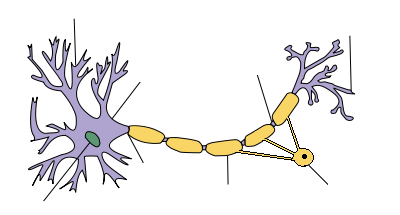
- neuron
- noun
- a specialized cell transmitting nerve impulses; a nerve cell.
- Example: The data collected from the human neuron culture suggests the ability to study not only the electrical communication among the cultured neurons, but also allow examination of corresponding neurotransmitter releases.
- fr: neurone
- homeostasis
- noun
- the tendency toward a relatively stable equilibrium between interdependent elements, especially as maintained by physiological processes.
- Example: Each input or interaction upsets homeostasis, but the parts which make up the system are programmed to respond in such a way as to ensure a return to normality.
- fr: homéostasie
- gland
- noun
- An organ which produces and releases substances that perform a specific function in the body.
- Example: The name thyroid-stimulating hormone ( TSH) has been given to a substance found in the anterior pituitary gland of all species of animal so far tested for its presence.
- fr: glande
- etiology
- noun
- The investigation or attribution of the cause or reason for something, often expressed in terms of historical or mythical explanation.
- Example: This work shows that the assumed association between circular migration and STD transmission at home depends on the etiology of disease and social climate.
- fr: étiologie
- fontanel
- noun
- A space between the bones of the skull in an infant or fetus, where ossification is not complete and the sutures not fully formed. The main one is between the frontal and parietal bones.
- Example: The four sutures come together at the fontanel, or "soft spot" in a baby's head.
- fr: fontanelle
- neuroplasticity
- noun
- The ability of the brain to form and reorganize synaptic connections, especially in response to learning or experience or following injury.
- Example: The development of the human brain, perception, cognition, memory and neuroplasticity are unsolved problems in neuroscience.
- fr: plasticité célébrale
- soliloquy
- noun
- An act of speaking one's thoughts aloud when by oneself or regardless of any hearers, especially by a character in a play.
- Example: By the end of his soliloquy Hamlet concludes that he should not murder Duncan.
- fr: soliloquie
- centration
- noun
- In children at an early stage of cognitive development: the tendency to focus attention exclusively on a single salient feature of an object or situation, and neglect other relevant features; an instance of this.
- Example: Perhaps the most famous task indicative of centration is the conservation of liquids task.
- fr: centration
- seriation
- noun
- The process of arranging a collection of items in a specific order (series) on the basis of a particular dimension (e.g., size).
- Example: It is during this stage that the abstract principle of thinking called "seriation" is naturally developed in a child.
- fr: sériation
- identity
- noun
- Identity is the qualities, beliefs, personality, looks and/or expressions that make a person (self-identity as emphasized in psychology) or group.
- Example: In addition, this analysis assists in considering the identity of the inhabitants as well as the possible reasons that the community spread to Anatolia.
- fr: identité
- biopsychosocial
- noun
- Of, relating to, or concerned with the biological, psychological, and social aspects in contrast to the strictly biomedical aspects of disease.
- Example: Behavioral medicine uses the biopsychosocial model of illness instead of the medical model.
- fr: biopsychosocial
- stress
- noun
- A state of mental or emotional strain or tension resulting from adverse or very demanding circumstances.
- Example: Physiological stress indicators (blood pressure and heart rate) were also obtained at 15-minute intervals.
- fr: stress

- psychoanalysis
- noun
- A system of psychological theory and therapy which aims to treat mental disorders by investigating the interaction of conscious and unconscious elements in the mind and bringing repressed fears and conflicts into the conscious mind by techniques such as dream interpretation and free association.
- Example: Sigmund Freud (1856-1939) is known as the father or psychoanalysis.
- fr: psychanalyse
- humanism
- noun
- An outlook or system of thought attaching prime importance to human rather than divine or supernatural matters. Humanist beliefs stress the potential value and goodness of human beings, emphasize common human needs, and seek solely rational ways of solving human problems.
- Example: The first school' which came into being under the immediate influence of humanism was that founded at St Paul's by Dean 1 See also the article Schools.
- fr: humanisme
- behaviorism
- noun
- The theory that human and animal behavior can be explained in terms of conditioning, without appeal to thoughts or feelings, and that psychological disorders are best treated by altering behavior patterns.
- Example: The dead hand of behaviorism still deforms the study of consciousness.
- fr: béhaviorisme
- neurology
- noun
- The branch of medicine or biology that deals with the anatomy, functions, and organic disorders of nerves and the nervous system.
- Example: Imagine a scientist in the distant future who knows everything about the mechanism and neurology of vision, but who is blind from birth.
- fr: neurologie
- stimulus
- noun
- A thing or event that evokes a specific functional reaction in an organ or tissue.
- Example: It allows the psychologist to determine whether the subject has detected a change in a stimulus or can discriminate between two stimuli.).
- fr: stimulus
- cognition
- noun
- The mental action or process of acquiring knowledge and understanding through thought, experience, and the senses.
- Example: The philosophical tradition she is working within is Kantian: she emphasises that human cognition is an "active process of taking and structuring experience", and therefore, she argues, a process that entails freedom and responsibility and the associated ethical virtues of honesty, humility and courage.
- fr: cognition
- heuriostic
- adjective
- Enabling a person to discover or learn something for themselves.
- Example: It is a heuristic process liable to failure, and its application by a nation of talkers even to physics where non-expert opinion is worthless somewhat discredited it.
- fr: heuristique
- psychology
- noun
- The scientific study of the human mind and its functions, especially those affecting behavior in a given context.
- Example: The second consisted of persons with non-medical doctorate degrees such as: Doctorate of Philosophy, Doctorate of psychology, and Doctorate of Education.
- fr: psychologie